


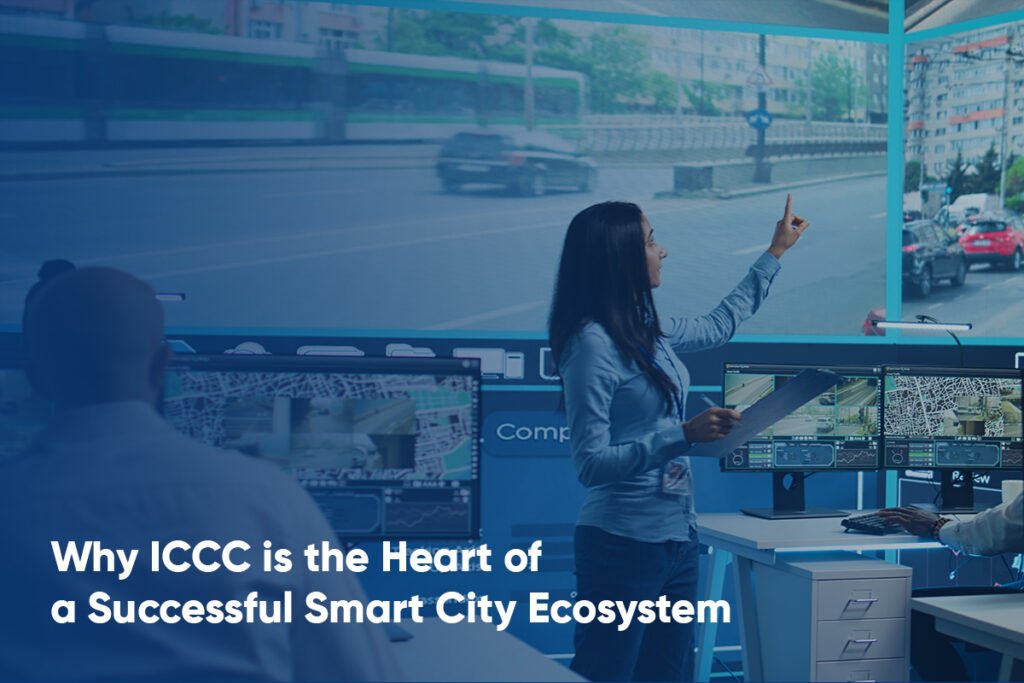
Smart cities look glamorous on paper. Apps for everything. Sensors everywhere. Dashboards that promise “real-time” control. But in the real world, a city is messy. Traffic doesn’t wait for your pilot project to finish. Water leaks happen at 3 a.m. Festivals create sudden crowd pressure. One small incident can spiral fast if teams don’t see the same information at the same time.
That’s where the ICCC comes in. It’s not just another control room with big screens. It’s the place where a city’s data, departments, and decisions meet. When it’s done right, it turns scattered systems into a coordinated ecosystem.
The Problem Smart Cities Face Without a Central Brain
Most cities don’t suffer from a lack of technology. They suffer from “too many tools, too little alignment.”
One department has traffic cameras. Another has emergency response protocols. Another monitors street lights. Another has a complaint system. Everyone is working, but everyone is working separately. That means:
-
- Alerts come in, but they go to the wrong team first.
-
- The same incident gets reported five times on five platforms.
-
- Decisions are slow because nobody has a shared, verified view.
-
- Citizens feel ignored because the resolution takes forever.
A smart city becomes truly smart when it can act like one unit, not fifty disconnected parts.
So, What Does ICCC Stand For and Why Does It Matter?
ICCC stands for Integrated Command and Control Centre. The name is long, but the idea is simple: one place to watch, understand, coordinate, and respond.
Think of it like an air traffic control tower, but for the city. It doesn’t replace departments. It connects them. It doesn’t “do the work” itself. It makes sure the right people get the right information, quickly, with context.
And when a city has that level of coordination, everything gets smoother: response time improves, resources get used better, and decisions are less “guesswork” and more “based on what’s actually happening.”
What an Integrated Command and Control Centre (ICCC) Actually Does Day to Day
It’s easy to imagine ICCC only during emergencies. But the real value shows up in daily operations too.
A strong ICCC typically helps cities:
-
- Monitor Key Services: traffic flow, public transport, water supply, waste pickup, and power outages.
-
- Track Incidents and Complaints: logging, assigning, escalating, and closing with accountability.
-
- Coordinate Departments: one incident, one ticket trail, shared updates.
-
- Improve Planning: patterns over weeks and months help prevent repeats.
The difference is subtle but huge. Instead of reacting randomly, the city starts reacting intelligently.
The Role of a Smart City Surveillance System (and Why It’s Not Only About Security)
Surveillance is a loaded word, so let’s be honest about it. People worry about privacy, misuse, and “being watched.” Fair concerns. But in many city contexts, surveillance is less about spying and more about safety and operations.
A smart city surveillance system can help with:
-
- Crowd management at public events
-
- Identifying accident-prone junctions
-
- Faster response to fire, intrusion, and vandalism
-
- Supporting emergency teams with visual confirmation
The key is governance. Clear policies. Access controls. Logs. Retention rules. When those guardrails exist, surveillance becomes a tool for prevention and quick response, not a vague fear.
Why Command Centre Software Determines Whether the ICCC Succeeds
You’ve probably seen those command centres that look impressive but don’t actually change outcomes. A wall of screens, dozens of feeds, and still, the ground teams rely on phone calls and WhatsApp messages.
That usually happens when the command centre software is weak, fragmented, or hard to use.
The software is what turns feeds into actions. It should help with:
-
- Unified dashboards instead of 12 separate logins
-
- Automated alerts with priority tagging
-
- Clear workflows: who owns what, by when
-
- Integration with citizen apps and complaint systems
-
- Reports that don’t take three days to compile
In other words, the command centre should not just “see.” It should help the city decide and act.
Real Success Looks Boring (In a Good Way)
A successful ICCC may not look dramatic, but it delivers measurable operational improvements: fewer breakdowns, faster closures, cleaner escalation, reduced duplication, and more predictable service delivery.
It also builds trust. Because when citizens complain and actually see resolution, they stop feeling like the city is ignoring them. And when departments share information smoothly, they stop blaming each other and start solving together.
How We Support Smart City Teams at Intellve
At Intellve, we believe an ICCC should feel practical, not complicated. It should help city teams work faster on normal days and stay in control on chaotic days. We focus on building solutions that connect systems cleanly and make daily operations easier, not heavier.
Here’s what we typically help with:
-
- Bringing multiple city data sources into one operational view
-
- Setting up incident workflows so ownership and escalation are clear
-
- Making dashboards usable for real teams, not just presentations
-
- Enabling role-based access so the right people see the right data
If a city is aiming to move from “smart projects” to a genuinely smart ecosystem, we’re happy to help make the ICCC layer strong and scalable.
Conclusion
ICCC is the heart of a smart city because it connects everything that usually stays disconnected: data, departments, and decisions. A city can have great sensors, apps, and infrastructure, but without a central command layer that coordinates response and accountability, it stays fragmented. When an ICCC is planned with the right integrations, workflows, and software foundation, it turns smart city ambition into everyday impact that citizens can actually feel.