
Many organisations assume that bringing AI into surveillance means ripping everything out and starting again. New cameras. New software. New workflows. New complications.
In real life, it usually does not need to be that dramatic.
Most existing surveillance systems already have the basic building blocks in place. They have cameras, recording systems, storage, operators, and a monitoring routine. The real question is not whether everything must change. The question is whether we can make the current setup smarter without breaking what already works.
That is where AI integration becomes practical. Instead of treating the old system as useless, teams can build on top of it. They can connect analytics, alerts, visual dashboards, and centralised monitoring to improve how incidents are detected and handled. That is usually a more practical route for most businesses and public projects. For example, a cloud-based monitoring platform can help organisations consolidate multiple assets across sites into a single integrated system.
First, Check the System’s Weak Points
Before adding anything AI-led, it helps to be honest about where the current surveillance setup struggles.
Maybe operators are reviewing too many screens at once. Maybe alerts are delayed. Maybe the footage is recorded properly, but searched badly. Maybe sites are spread across locations, and nobody gets a clear view. Those problems matter because AI works best when it solves a real operational gap, not when it is added just because the word sounds impressive.
It is also the stage where teams should check compatibility. Can the current VMS, cameras, or command platform accept external analytics or smart integrations? Can the system handle centralised alerts? Can it support live visualisation across sites? These are the questions that shape a smoother rollout.
Add AI in Layers, Not All at Once
This step is important. AI integration usually works better in stages.
Trying to switch everything on at once often creates confusion. Too many alerts. Too many changes for operators. Too much pressure on the team to “use AI” before the setup has even settled. A better approach is to start with one or two clear use cases. Intrusion detection. Unusual movement. Queue build-up. Perimeter breach. Vehicle monitoring. Something measurable.
Once that works, the system can expand.
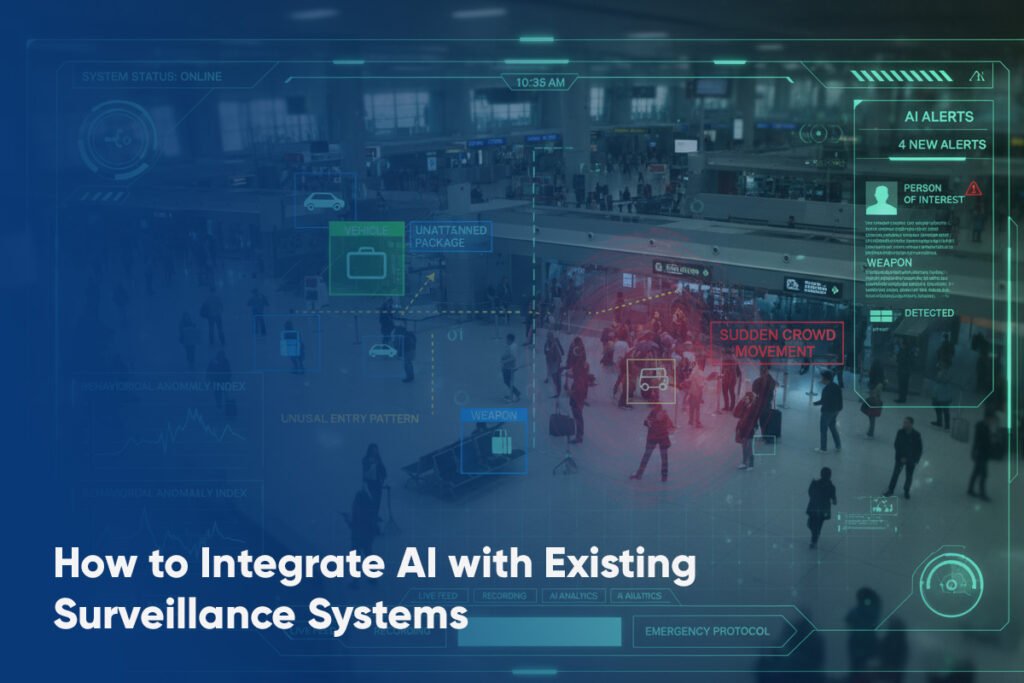
That is also where an ai powered surveillance camera setup can help. The camera itself does not have to replace the whole surveillance environment. It can become a smarter input inside a wider system. Used properly, it helps reduce manual watching and improves the speed of basic detection. Some modern remote monitoring platforms combine video management, analytics, alert systems, and data visualisation to detect anomalies in real time.
Focus on Workflow, Not Just Detection
A common mistake is treating AI detection as the whole story. It is not.
Yes, AI can flag an issue faster. But what happens next? Who sees the alert? Where does the event appear? Can someone verify it quickly? Can they act from the same interface, or do they still have to jump between systems? If the workflow stays messy, the technology only solves half the problem.
That is why visualisation matters so much. AI becomes more useful when alerts, camera feeds, and site information converge into a single, readable operational view. A team under pressure should not have to stitch the incident together on its own.
It is one of the real benefits of AI surveillance. It not only helps spot anomalies but also helps operators respond with greater confidence by providing faster context. And that changes the quality of decision-making in a very practical way. Many platforms today are designed around real-time monitoring, response, and data-led visibility across sectors such as smart cities, logistics, retail, and critical infrastructure.
Keep High-Risk Environments Front and Centre
Integration becomes even more important in environments where delays are costly or dangerous.
That includes transport, utilities, industrial operations, urban systems, and video surveillance for critical infrastructure. In those settings, surveillance is not just for recording incidents after the fact. It supports continuity, safety, and rapid intervention. If AI can help identify abnormal activity earlier and present it clearly, it becomes part of operational resilience, not just security.
In high-risk environments, integrated command-and-control systems are often used to support real-time monitoring and response across large deployments.
Train the Team Alongside the Technology
This part gets skipped more often than it should.
Even a strong AI layer will disappoint if the people using it do not trust it or understand it. Operators need to know what the system is detecting, what counts as a meaningful alert, how false positives are handled, and when to escalate. Otherwise, the technology becomes background noise.
That is why integration should include training, testing, and small adjustments after launch. Let the team work with it. Let them question it. Let them see where the alerts help and where the rules need refining. AI works far better when it feels like an operational assistant, not an unpredictable extra screen.
It is where AI-powered security cameras should be introduced carefully. They can add strong value, but only if they fit into the way people already monitor, verify, and respond.
How We Look at This at Intellve
At Intellve, we see AI integration as a way to strengthen what organisations already have, rather than forcing them into a disruptive restart. Our focus is on making surveillance systems more connected, more readable, and more responsive in day-to-day operations.
-
- We help bring video, alerts, and operational inputs into one clearer view.
-
- We support real-time detection and response across sites and geographies.
-
- We build for environments where visibility, control, and timely action really matter.
Conclusion
Integrating AI with existing surveillance systems is usually less about replacement and more about improvement. The smartest approach is to start with the current setup, identify the gaps, add AI in stages, and ensure the workflow improves, not just becomes more complicated.
Because in the end, that is what good integration should do. Do not overwhelm the system. Just make it sharper, faster, and more useful when people need it most.