


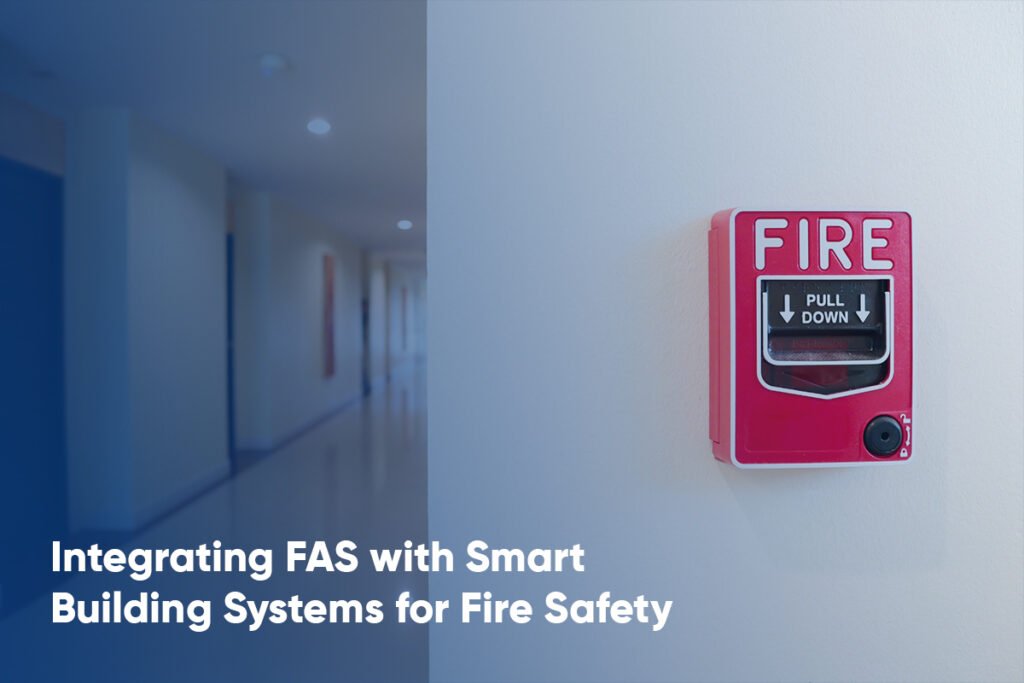
Fire safety in a modern building is not only an alarm panel and a set of sirens. Buildings today behave more like living systems. Doors are controlled. Lifts follow programmed rules. HVAC moves huge volumes of air. Lighting, public address, and security monitoring all run in parallel. In a fire incident, those systems can either support safe evacuation and faster response, or they can quietly make the situation worse. That is why integrating a Fire Alarm System (FAS) with smart building systems is now treated as a practical safety decision, not a technology project.
A strong integration is easy to explain in plain words: the moment a fire event is detected, the building should respond in a predictable way. People should be guided out. Smoke should be managed. Responders should get usable information quickly. And the control room, supported by integrated control room software, should not be forced to “translate” between five different screens while the event is unfolding.
Why FAS Integration Matters in Smart Buildings
A stand-alone FAS is good at detection and notification. It triggers sounders, strobes, and the fire panel event. The weakness appears when other systems keep behaving as if nothing happened. Air handling may continue to circulate air and spread smoke. Access-controlled doors may remain locked in areas where safe egress is required. Lifts may still look available, which encourages unsafe choices. Even when staff are trained, pressure changes behaviour. People forget steps. Radios get busy. Updates arrive late.
Integration reduces that human dependency. It makes the fire event the “master signal” that coordinates what the building does next. The response becomes consistent across shifts, across sites, and across different teams, which is exactly what you want during an emergency.
How Building Systems Should React When an Alarm Triggers
Smart building integration works best when it focuses on a few systems that directly influence life safety. The goal is not to connect everything. The goal is to connect what matters.
Typical coordinated actions include:
-
- HVAC switching to a smoke control mode (or stopping where required)
-
- Lift recall to defined safe floors, with normal lift use disabled
-
- Access control overrides for safe exit paths, while maintaining controlled separation where needed
-
- Emergency lighting and exit signage activation for clear wayfinding
-
- Public address or mass notification that gives simple, unambiguous instructions
-
- Automatic alert routing to on-site response and facility leadership
These actions remove the delay. They also remove conflicting behaviour, such as one system pushing smoke while another is trying to clear it, or exit routes being blocked by default security settings.
Visual Confirmation Helps Teams Move Faster
Not every alarm turns out to be a confirmed fire, but every alarm must be treated seriously until it is verified. Dust, steam, cooking fumes, and maintenance work can trigger detectors. The difference between “verify quickly” and “hunt for information” is often several minutes, and those minutes matter.
A well-designed CCTV monitor setup makes verification easier by automatically pulling up the most relevant camera views linked to the alarm zone. Instead of searching through dozens or hundreds of feeds, operators can see the corridor, stairwell, or plant area in question immediately. That shortens triage time, improves decision quality, and helps responders avoid going in blind.
Video Adds Context, Not Replacement
Fire detection must remain code-compliant and certified. Video is not a replacement for certified detectors, panels, or signalling logic. But video can add context once an event begins, and that context reduces the likelihood of poor decisions.
With advanced video protection, teams can use analytics and event workflows to reduce noise and focus attention. For example, rather than watching a wall of cameras, operators can be guided to the feeds that matter most during an incident: exit routes, assembly areas, critical plant rooms, or zones with higher fire load. In real-world events, that clarity helps with routing, crowd management, and faster escalation when conditions visibly worsen.
One Operational Picture in the Control Room
A common failure point in emergencies is fragmentation. The fire panel shows zones and devices. Security software shows cameras. Access control shows door states. The building management system shows HVAC. If these stay separate, operators spend time stitching together a story while the incident keeps moving.
This is where integrated control room software becomes valuable. A unified view can present the alarm location, relevant cameras, door-release status, lift-recall state, and alert workflow in one place. It is not about making things look sophisticated. It is about making responses simpler: fewer clicks, fewer handoffs, fewer misunderstandings, and cleaner event records for review and compliance.
Build Integration for Resilience, Not “Perfect Conditions”
Emergency systems must work when conditions are messy. Power transitions happen. Networks degrade. Staff are busy. Information arrives in fragments. Integration should not add fragility.
Core fire detection and alarm functions must remain independent and compliant. Smart integrations should sit on top of that core and support it, without creating a single point of failure. In practice, that means:
-
- Fire actions override comfort automation and convenience settings
-
- Safe egress logic for doors is clearly defined and tested
-
- lift recall behaviour is documented and validated in drills
-
- alerts are routed through more than one channel with clear escalation
-
- Post-incident reporting is consistent because the system already tracks events
A reliable surveillance infrastructure supports this as well. If cameras fail, storage drops, or feeds go offline during an alarm, teams lose a critical layer of visibility. Resilience planning is not glamorous, but it is what keeps operations steady when it counts.
How Intellve Makes It Possible
At Intellve, we focus on making safety operations work in real buildings, not only in neat diagrams. We design integrations so that fire events trigger clear, coordinated actions, and the control room has usable visibility quickly.
If you want an integration approach that prioritises reliability and real operations (not complexity), Intellve can help you plan and implement a fire safety integration that supports coordinated response, practical visibility, and stronger day-to-day readiness. Reach out to discuss how your building can move from “separate systems” to a safer, more connected response.