


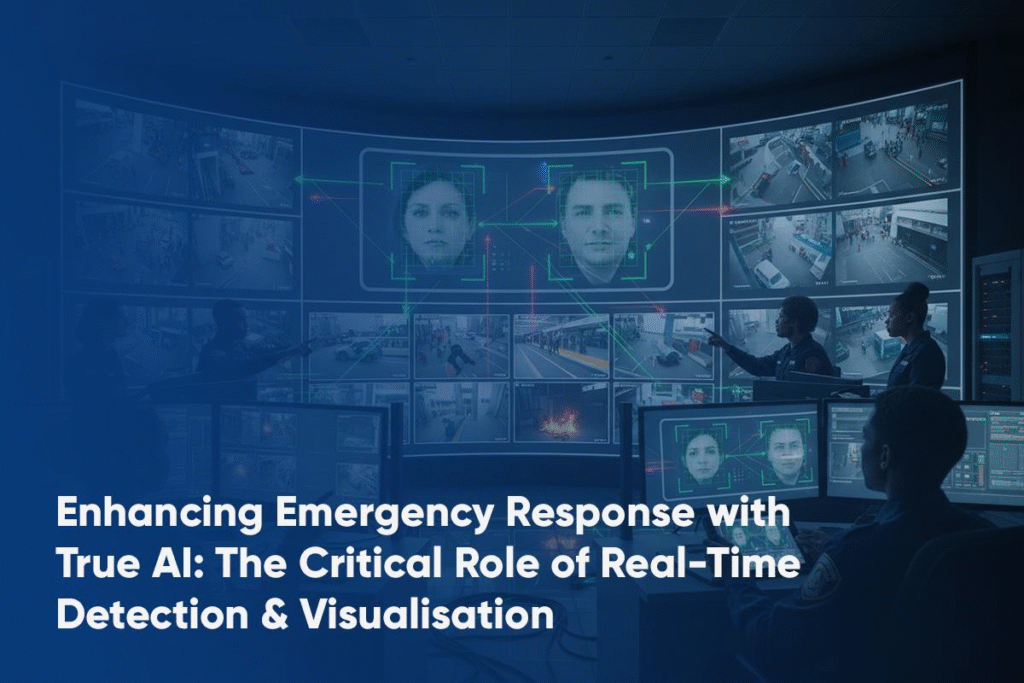
Emergency response has always depended on one critical factor: time. The ability to detect a problem quickly, understand its context, and respond before the situation escalates.
That sounds obvious, but in real situations, the delay rarely happens because people do not care. It happens because they do not see enough early enough. A camera records something. An alert comes in. A guard checks one screen while another incident is already unfolding elsewhere. By the time the full picture is clear, the moment to act fast has already slipped a bit.
That is exactly where true AI starts making a difference.
Not the flashy kind people throw into presentations. The useful kind. The kind that helps teams detect unusual activity in real time, connect scattered signals, and turn a confusing stream of footage into something people can actually respond to.
Detection Is Only Helpful If It Happens Now
Many security systems still operate in a backward way. They record everything and help people investigate after something has already gone wrong. That has value, sure. But post-incident review is not the same thing as active response.
In an emergency, the goal is not just to know what happened. It is important to know what is happening right now.
That is why artificial intelligence-based CCTV monitoring has become an important part of modern emergency operations. Instead of relying only on human eyes to scan endless footage, AI can flag motion patterns, crowd build-up, perimeter breaches, vehicle anomalies, or unusual behaviour the moment it starts to look wrong. That gives response teams a head start, and sometimes that head start is the whole game.
That difference defines whether teams are reacting to incidents or actively controlling them.
Visualisation Turns Noise Into Action
Detection alone is not enough, though. This step is often overlooked in traditional monitoring systems.
You can have alerts flying in every minute. Still, if operators cannot quickly understand where the issue is, how serious it is, and what else is connected to it, the system creates stress rather than clarity. A hundred alerts are not useful if they all feel equally urgent.
Real-time visualisation helps fix that.
When video feeds, alerts, maps, sensors, and site-level events are brought into one operational view, teams stop chasing fragments. They start seeing context. A blocked gate is not just a blocked gate anymore. It may connect to a crowd surge, an access issue, a fire alert, or an unauthorised vehicle movement nearby.
That is where an artificial intelligence CCTV camera setup becomes more powerful than a traditional camera network. It is not just capturing footage. It is feeding a system that helps people evaluate what they are looking at while the situation is still developing.
And that matters. Because in emergencies, clarity is not a luxury. It is part of the response.
Why Remote Monitoring Changes The Response Model
Old-style emergency setups often depend too heavily on who happens to be physically present at one site. That creates blind spots. If the decision-makers are elsewhere or the site team is stretched thin, response slows.
A strong remote monitoring system changes that completely.
It allows teams to watch multiple locations, compare events across sites, and escalate issues without waiting for information to travel through too many layers. That is especially useful for distributed operations like smart cities, transport hubs, industrial areas, warehousing networks, and retail chains. Emergencies do not politely happen in one place at a time. Systems have to be built with that reality in mind.
Remote monitoring also helps reduce hesitation. When operators can verify an event visually and instantly, they are less likely to waste time second-guessing what they are seeing.
Real-Time Video Matters In High-Movement Environments
Some environments are especially unforgiving when responses are slow. Logistics is one of them.
In fast-moving facilities, problems escalate quickly. A loading zone backup, an unauthorised entry, a vehicle conflict, or a safety breach can affect people, goods, schedules, and site security all at once. That is why logistics real-time video surveillance is becoming more critical for operational planning. It helps teams spot disruptions as they unfold, rather than hearing about them only after the workflow has already been disrupted.
And once again, the key is not just “watching”. It is “detecting”, “visualising”, and “acting” from one clear operational picture.
Why This Approach Matters To Us At Intellve
At Intellve, we look at emergency response as something that depends on visibility, speed, and practical control, not just raw data.
Our solutions bring together video feeds, alerts, and operational events into a single monitoring view so teams can detect anomalies and respond faster.
-
- We focus on bringing alerts, video, and operational inputs into one usable view.
-
- We support faster decisions by helping teams detect anomalies and act in real time.
-
- We build for environments where response delays can quickly turn into bigger risks.
Conclusion
True AI in emergency response is not about adding buzzwords to surveillance. It is about making systems more useful under high pressure and short time. Real-time detection helps teams notice what matters. Real-time visualisation helps them understand it. Together, they create a smarter, faster response model that is built for real-world complexity, not ideal conditions.
Ultimately, that is the goal. In an emergency, people do not need more footage. They need better visibility, quicker judgment, and a system that helps them act before the situation gets worse.