

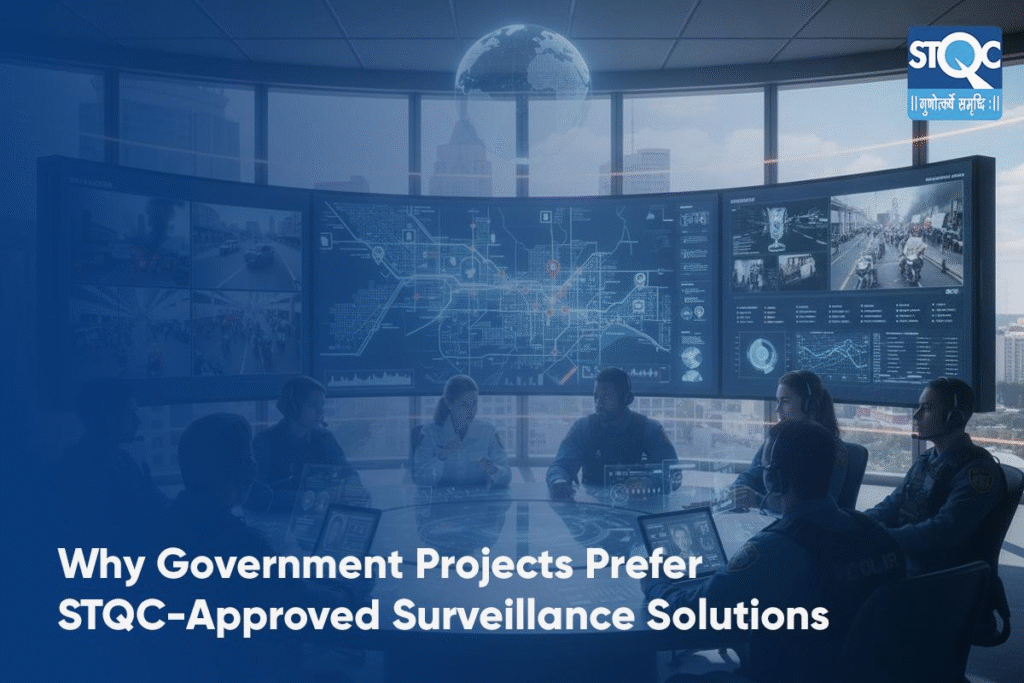
Government surveillance projects are rarely small. They cover city roads, transport hubs, public buildings, utilities, command centres, and other spaces where safety, accountability, and continuity matter every day. In setups like these, a camera is not just a camera.
It becomes part of a much larger public system. That is one of the key reasons government buyers tend to prefer STQC-approved CCTV over products that only look good on paper. STQC is the Standardisation Testing and Quality Certification Directorate under MeitY, and it runs the IoT System Certification Scheme for CCTV evaluation and certification.
Certification Brings Structure to Procurement
In private buying, a team might take more chances. A lower price or a familiar vendor may be enough to close the deal. Government procurement works differently. It needs clearer benchmarks, stronger documentation, and more defensible decisions.
That is where STQC certification for CCTV becomes useful. It gives agencies a formal path to assess whether products meet notified essential requirements, rather than relying solely on brochures, demos, or sales claims. STQC’s official CCTV procedure spells out a defined process for testing, evaluation, and certification under its IoTSCS scheme.
Security Is Now Part of the Product Conversation
There was a time when surveillance buying focused heavily on image quality, storage, and price. Those things still matter. However, government projects now have to take product security and trust more seriously. STQC’s IoTSCS is built around assurance levels and certification requirements for IoT systems, including CCTV, which makes the conversation much broader than basic hardware features.
That is why a valid STQC certificate for CCTV matters. It signals that the evaluation has been conducted through a recognised government-backed framework, not just through a manufacturer’s own checklist.
Long-Term Deployments Need Long-Term Confidence
Most government surveillance systems are not short-term purchases. They are installed for long operational cycles and often sit inside larger infrastructure projects. Once a city, department, or command centre deploys hundreds or thousands of devices, replacing weak products later becomes expensive and messy.
So buyers naturally lean toward products with more reliable upfront verification. Interest in STQC-certified CCTV camera brands in India has grown for exactly that reason, and STQC itself maintains certified product listings under the IoT System Certification Scheme.
Software Matters as Much as the Cameras
This part is easy to overlook. Government projects do not run on cameras alone. They depend on central visibility, alert handling, event review, integration, and coordinated response. That is why the conversation often expands beyond hardware to questions about the best VMS software for CCTV and broader platform capabilities.
A strong surveillance deployment needs software that can unify feeds, support monitoring at scale, and make response easier for operators dealing with live incidents rather than tidy lab conditions. For example, a cloud-based monitoring platform can help organisations track multiple assets across sites through one integrated system.
Large Public Systems Need More Than Basic Monitoring
For government environments, disconnected screens and siloed footage are no longer sufficient. Operations teams need one usable view of what is happening across locations, services, and alerts. That is where enterprise video management software solutions become important.
They help move surveillance from passive recording into something more active and operational. Many modern remote monitoring platforms combine video management, data visualisation, analytics, and alert systems to help operators detect anomalies in real time and respond faster.
Why This Preference Keeps Growing
The preference for STQC-approved solutions is not really about formality for its own sake. It is about reducing uncertainty. Government departments are expected to justify procurement choices, secure public environments, and support long-term service reliability. A certified framework helps them do that with more confidence.
It also aligns with the way public projects are evolving in India, where digital systems are expected to be more secure, better governed, and easier to audit over time. STQC’s official materials and memoranda on CCTV certification show that this is not a loose market trend but rather part of a defined regulatory direction.
How Intellve Supports Smarter Public Surveillance
At Intellve, we see this preference as completely practical. Government and critical-sector projects need systems they can trust, scale, and manage with clarity. Our role is not just to add more screens or more alerts.
It is to make surveillance environments more connected, more visible, and more responsive.
-
- We help unify monitoring across sites, feeds, and operational inputs.
-
- We support real-time response through clearer visualisation and smarter control.
-
- We build for environments where public safety, continuity, and accountability truly matter.
Conclusion
Government projects prefer STQC-approved surveillance solutions because the stakes are higher, the deployments are bigger, and the margin for error is smaller. Certification brings structure. Trusted software brings control. Together, they help public-sector teams build surveillance systems that are easier to justify, manage, and trust.